Signage
not brought to you by Xerox in four parts without commercial interruptions
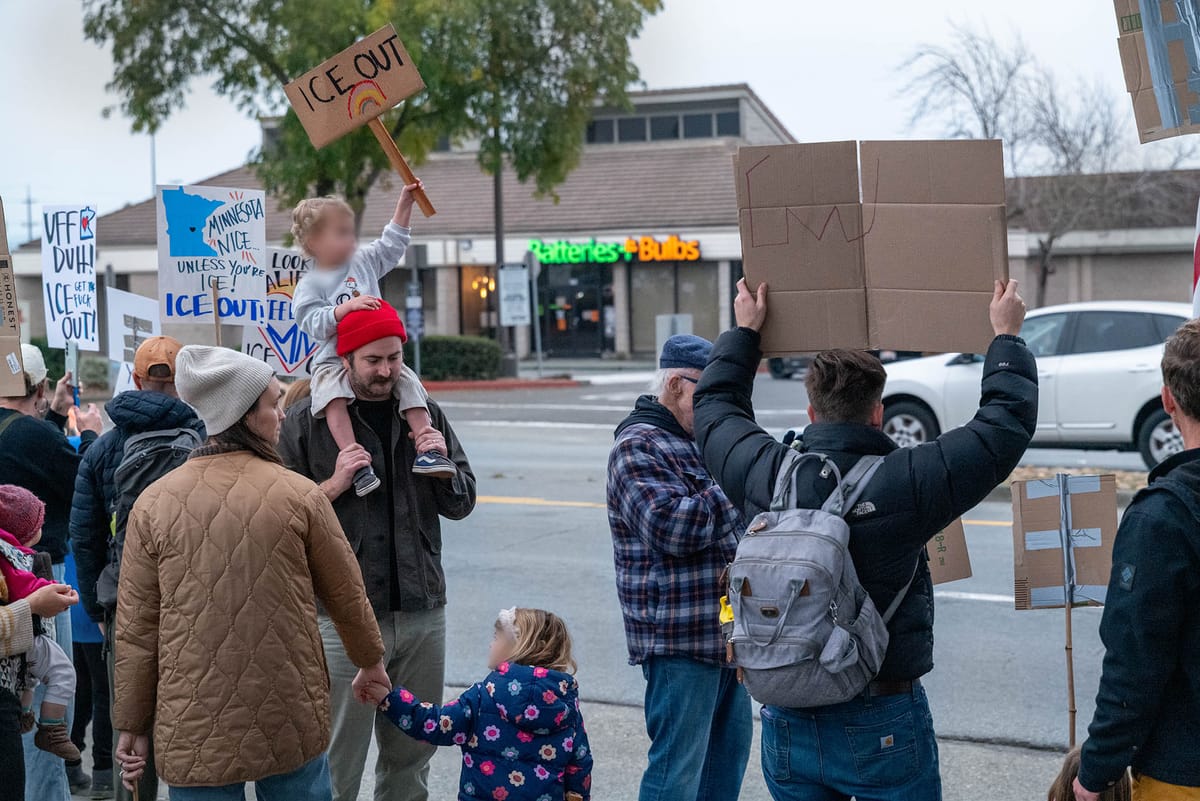
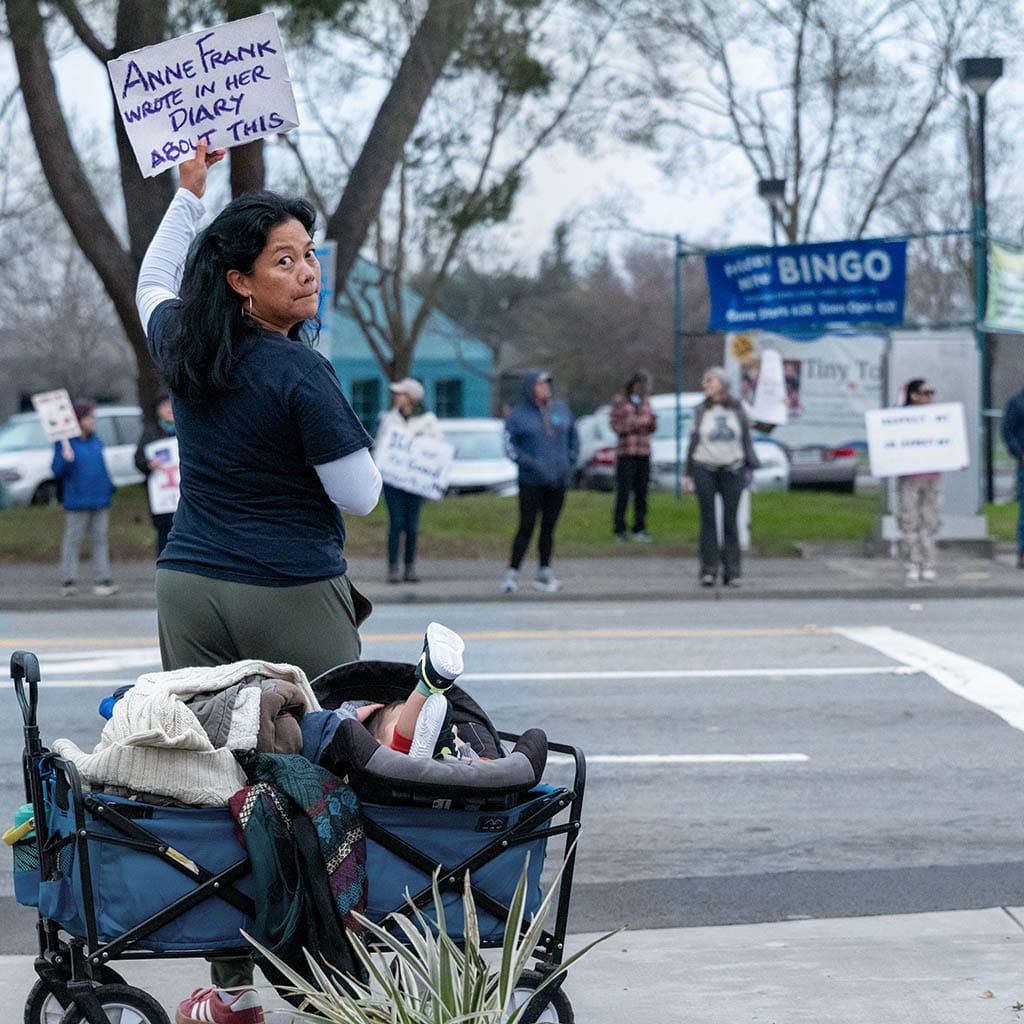
The Press Democrat tells me there were about 300 people waving signs alongside a Petaluma thoroughfare on January 23rd, the Friday before last: after the death of Renee Good, before that of Alex Pretti. The demonstrators' purpose was to show support for the people enduring ICE's "Operation Metro Surge" in Minneapolis. By the time I arrived the light and temperatures were declining but the rush hour traffic was at its peak. Cars slowed, honked their horns, flashed their lights. A very occasional oversized pickup would roll through carrying men who would shout profanities at the demonstrators, but by far the response was favorable.
I was glad to see a cross-section of the people in our smallish town: the pressing issues embodied in the conflicts around Minneapolis (and less-visibly: across the country) are serious. People getting out to demonstrate, to voice resistance and disapproval of ICE's violent and reckless disregard for law and due process is important.
I've made photographs of many marches and protests, loud or quiet, for causes I support and occasionally those I loathe, but I rarely share those photos to the "social" internet. To do so reminds me too much of Gil Scott-Heron's admonition:
The revolution will not go better with Coke
Posting photos of clever signs and costumes, especially ones with your grinning friends vamping, onto social platforms driven by advertising and managed by hidden algorithms in the hands of... well, the people funding and profiting from the very things you're protesting against, is, to use some old-fashioned language, to think that the tools of the oppressor will fight oppression.
Instagram and the like are highly-effective, low-cost, crowd-sourced versions of the circuses in Juvenal's ancient comment about bread-and. As a member of the circus crowd, it feels good to post online, there's the excited hope for a cloud of approving heart symbols on the posts. A tiny catharsis is achieved and you can dispel just that much more energy before the next post in the scroll reminds you about the six foods to never eat before bed (click here!) or the thrill of a new oversized pickup.
The acts of posting and receiving Likes are an exercise in affirming the status quo, the existing social order. The algorithms that manage who sees which posts have been designed and tested millions of times to ensure that people see very little that challenges any of their many external relationships – you only see the posts of people whose browsing patterns correlate to your own, and likewise no one whose browsing is unlike yours is likely to ever see what you post.
This, of course, means that if your post fits Things They Like, and it's guaranteed to be, because people are only fed the algorithm's advance determination of Things They Like (including, oddly, things that engage people's rage-share response, just as, say, does going to a sports stadium and shouting at the ump or some foreign-scum gladiator). Then you may well receive "Likes." You feel like you did something. The machine has provided you with Likes and Things You Like. Scroll for more.
Here's a paradox, then: to demonstrate and express opinions is good, but posting in online feeds about it... evaporates its energy. It casually squanders the energy of the demonstrator, it deflates the energy of the poster. It strengthens the unaccountable network owners. And yet in a society where everyone is staring at one scroll-feed or the next for most of their "communicative" or "social" time, how else to get those messages "Out There"?
Questions to ask yourself, when trying to answer: what audience are you actually seeking to reach (thank you, reader!)? What message are you really trying to send? What's its purpose? Try to be specific.
Around 1968 John Berger wrote
Theoretically demonstrations are meant to reveal the strength of popular opinion or feeling: theoretically they are an appeal to the democratic conscience of the State. But this presupposes a conscience which is very unlikely to exist.
In the current climate, that "State" includes politicians, platform owners, and the cluster of other attention merchants like them whose power grows, and benefits, from social media complaints about them on social media. The vaguer-yet-angrier the better, as the clicks pile up.
The truth is that mass demonstrations are rehearsals for revolution: not strategic or even tactical ones, but rehearsals of revolutionary awareness. The delay between the rehearsals and the real performance may be very long: their quality – the intensity of rehearsed awareness – may, on different occasions, vary considerably: but any demonstration which lacks this element of rehearsal is better described as an officially encouraged public spectacle.
On The Socials, all gardens are reduced to so much realistic astroturf. Social postings about demonstrations and protests: "better described as an officially encouraged public spectacle."
You will not be able to stay home, brother.
Some Petaluma-specific observations, while pondering "what to do?"
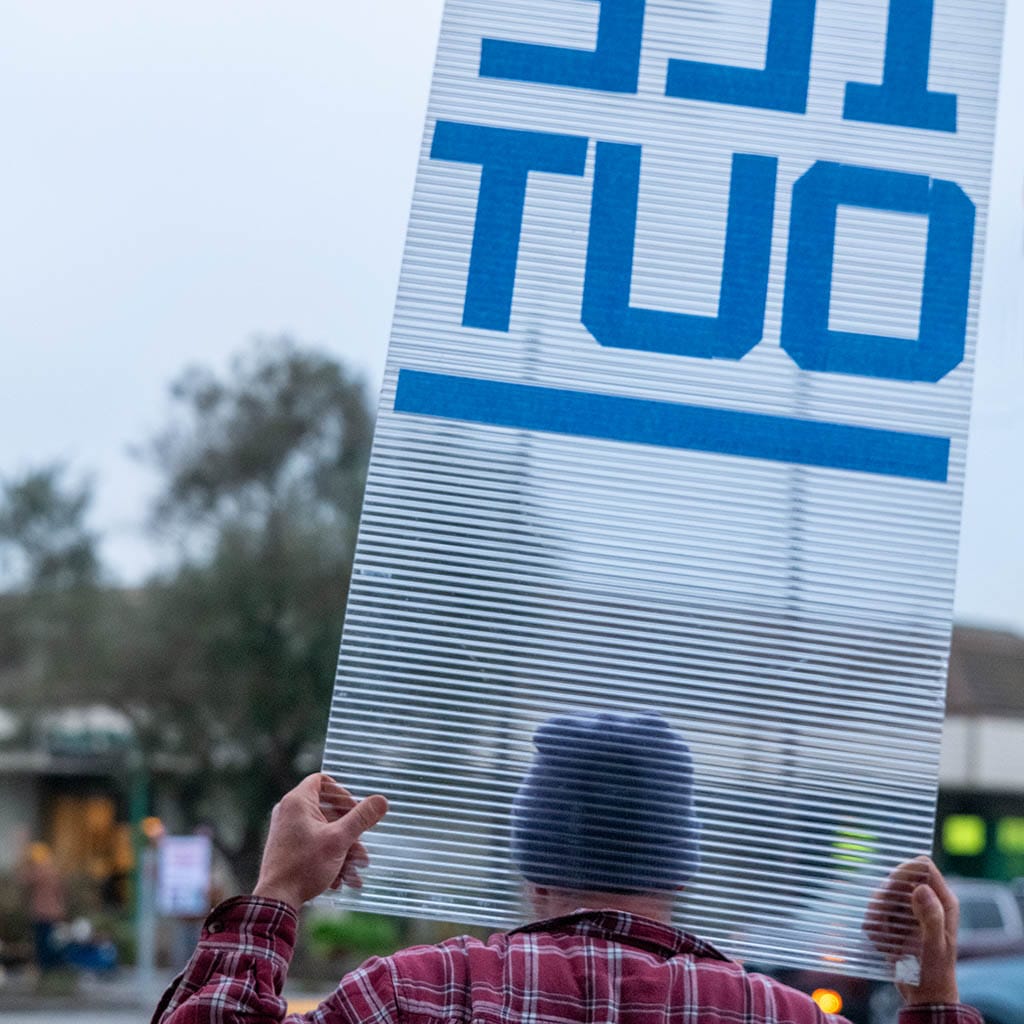
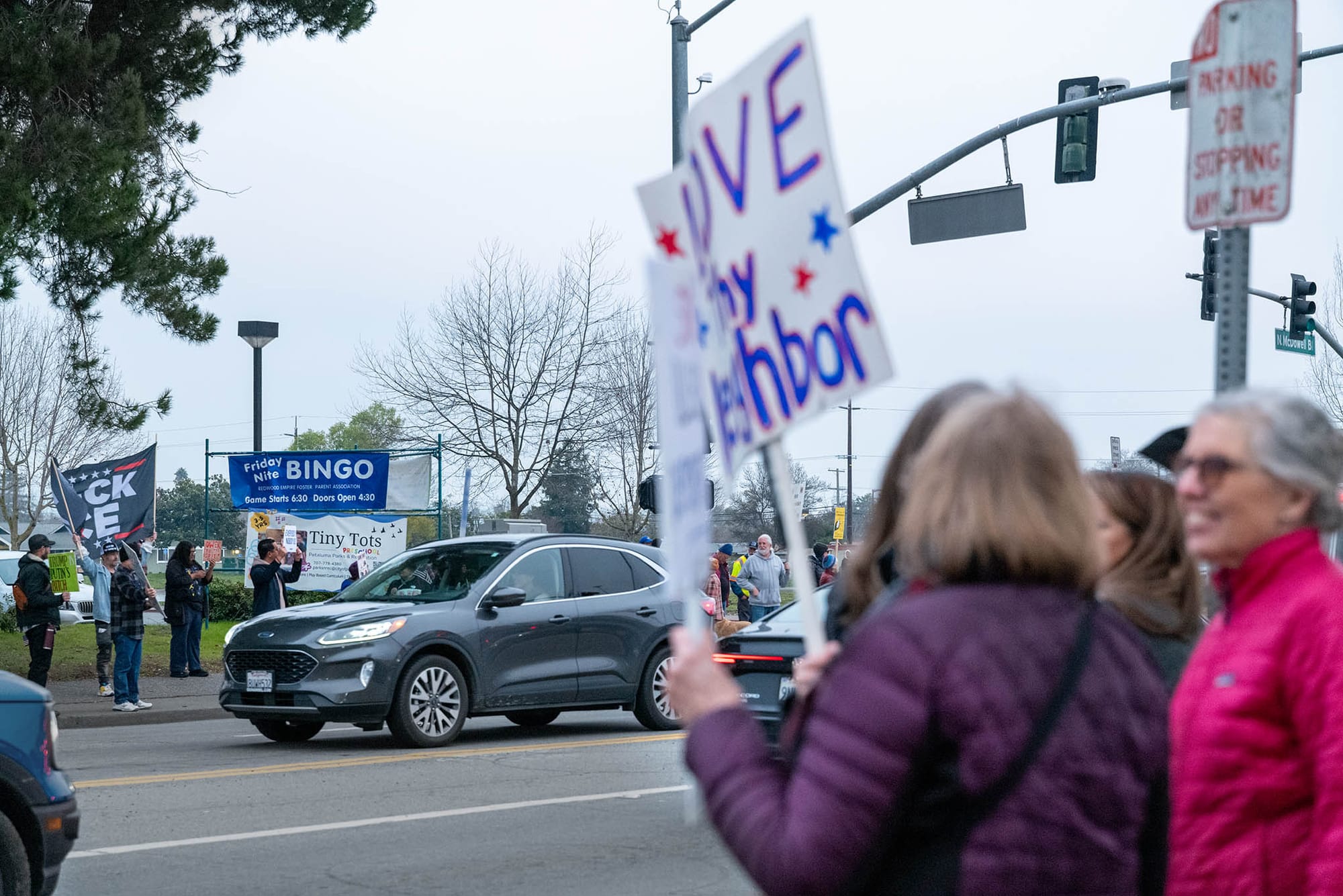
When making pictures of these demonstrators, I was trying to be a Good Photographer and get clear, simpler shots amid the clutter. I was struck by how much other signage already surrounded them, in the corridor between Lucchesi Park Community Center and the Plaza North Shopping Center.
Sometimes clear, simple shots might produce their own problems, in ways similar to reducing complex issues to 140 characters or a 20-second soundbite in a media "debate."
I was glad to see a few parents braving the chill with their children. Bringing your kids to a (peaceful) protest has benefits: it teaches kids that every person just might have a chance to make the world better, that families are important, that they are part of a mix of ages from toddler to seniors in wheelchairs, and the kids themselves are a sort of displayed sign: to those viewing the demonstration, the presence of children is an affirmation of Real Community, not just "shoppers like you."
(At the same time, children have something of a special status regarding privacy. They did not choose to be on the street, in the same way that an adult can choose. Rather than navigate all those issues I've made the rare decision to gently blur the faces of kids in photos for essays like this one)
Even little Petaluma has had much larger demonstrations opposing the policies of the current federal government. I was glad to see that this one was (mostly) issue-focused, rather than just generally griping about certain TV and Internet Celebrities in Washington. Repeating their names and getting incensed at them as media personalities is to vaporize your energy, to merely shout at the wind and the sea rather than pulling oars and steering the boat.
It's important to not fall into The Resentment Trap. To be resentful of Those People, to angrily care more than anything that They must be punished. The political attention entrepreneurs thrive on resentment. They encourage it, they drink deeply. They are the only beneficiaries, while the rest of us are poisoned. Social media's over-amplification of rage may drive clicks but it also prevents any chance for injuries, real or imagined, to ever have a chance to heal. Let them heal.
A complaint I've heard repeated by Those In Power has been that the signs of protestors look too good, too "professional." As if people who aren't employees couldn't make a proper sign without being paid to do it. As if mere people have no opinions other than what they've been told to have, by someone more important (and wealthier, apparently). I present a small counter-example: a snapshot of signs being made in the back yard by a family member to share with other 2020 demonstrators in San Francisco. I guarantee: no one was paid.
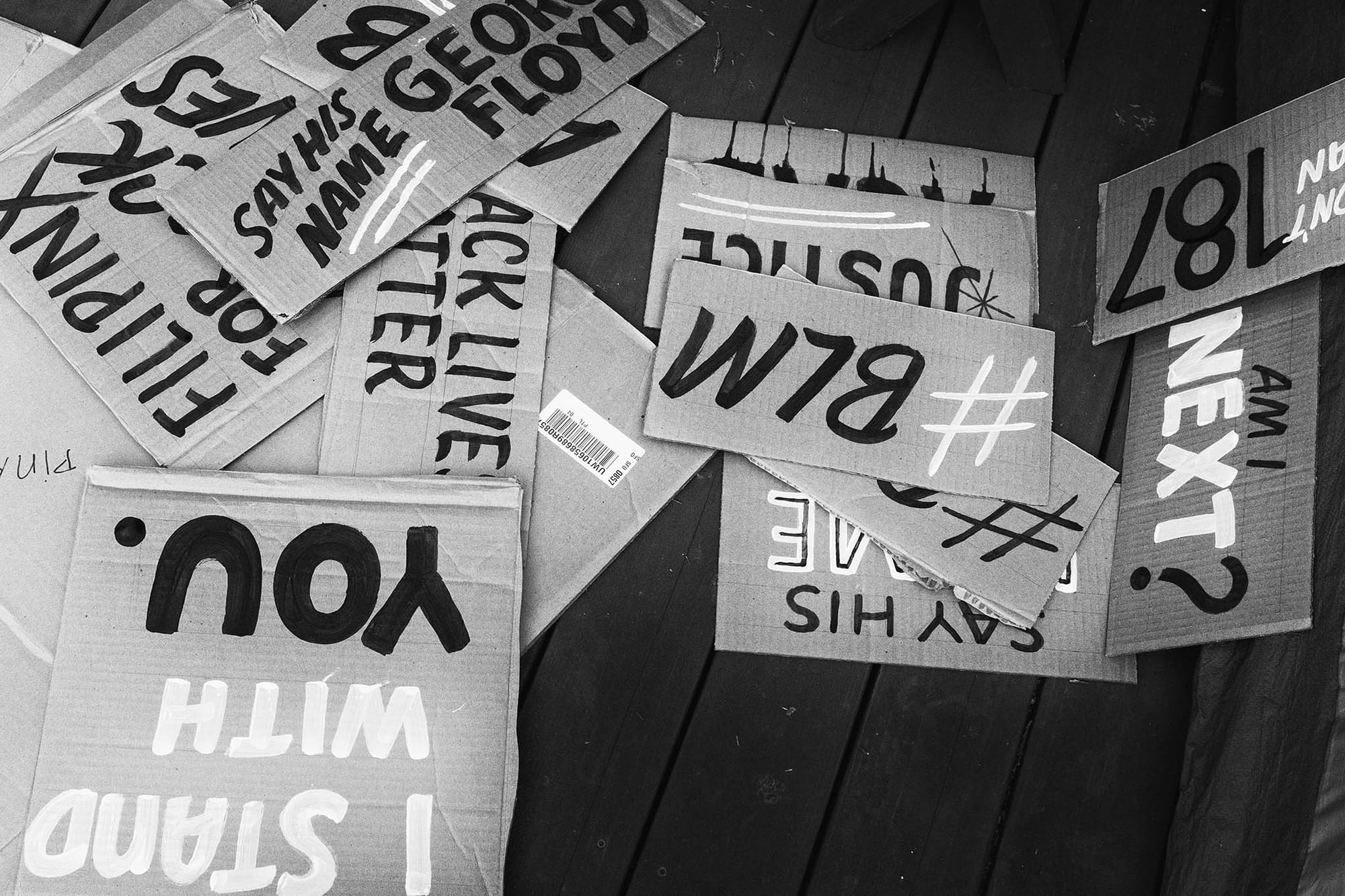
Bring what you can to the issues that matter to you. If you can make a good-looking sign, make it. If you can make a so-so sign with an honest message, make it. If you can wave that sign, wave it. If you can snap photos and write, do that. Talk to your neighbors. Change doesn't come from sitting on the couch scrolling.
I would be remiss not to share this recent note from Nina Litovsky The Visual Trap of Photographing Protests, and Why Documenting Them Matters. It does. She has good suggestions on how. Tyrants pass, but history is long and sometimes people learn something.
It's hard to pay attention everywhere, but don't think as a suburbanite you need to go downtown to make a point about the world you want for yourself and the people around you.
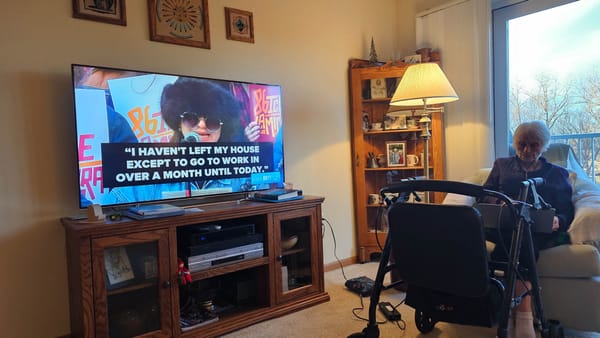
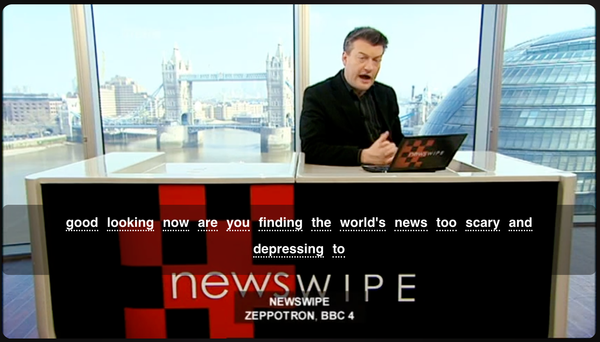
NBC will not be able predict the winner
At 8:32 on report from twenty-nine districts
Petaluma is a smaller town and it's easy to think that Important Statements should be made in Big Cities. Historically, demonstrations have been an urban activity. But even small towns have been affected by the current "surge," as you can see in a terrifying video from rural Minnesota of a group of agents cutting-off the car of an observer in the middle of the road and then leaping out to attack her, guns drawn. Would you believe it if you hadn't seen it?
Pictures can be powerful. Don't waste them.